
How to Write an Academic Paper Faster (Don't Write It in Order)
You open the document. At the top, in bold, sits the word Introduction. The cursor blinks underneath it. And you sit there, because writing a good introduction means knowing exactly what your study contributes — and right now, three weeks before the deadline, you are not sure you know that yet.
So you write a sentence. You delete it. You go and re-read a paper you already know. An hour later the page under Introduction is still essentially empty, and you have started to suspect you are just bad at writing.
You are not bad at writing. You are writing in the wrong order.
I finished my PhD on schedule and published 20 papers, and I will be honest with you: I am a fairly average researcher. I do not write faster than you, and I do not have more willpower. The single biggest change in how to write an academic paper without dreading it was this — I stopped writing the paper top to bottom. Once I started drafting in the order the material was actually ready, the work got faster and far less painful. This post hands you that exact sequence.
📄 Free template: Once you know the order, you still have to turn notes into prose — which is exactly what my free kit "From Notes to First Draft" is for: the note-to-paragraph workflow and templates I actually use. Subscribe to phd-compass and it lands in your inbox. No course, no upsell. Get it here.
Why writing "in order" is the trap
A finished paper reads in a fixed order: introduction, method, results, discussion. So it feels natural to write it in that order too. Start at the top, finish at the bottom.
The problem is that reading order and writing order are two different things, and confusing them is what kills your momentum.
Think about what the introduction actually has to do. It frames the gap your study fills. It sets up why your findings matter, and it promises the reader a specific contribution. But you cannot honestly frame the gap your results fill until you know what those results are. There is no point writing the perfect introduction before you know what you found — and if your analysis surprises you (it usually does), the beautiful introduction you spent a week on no longer fits, and you rewrite it anyway.
So the most abstract, most contingent, most rewrite-prone section of the whole paper is the one you are trying to write first, on a blank page, with the least information you will ever have. No wonder the cursor just sits there.
The fix is not to push harder at the introduction. It is to start somewhere your material is already solid.
The fix: write in readiness order, not reading order
Here is the principle that changed everything for me: draft each section in the order it is ready to be written, not the order the reader will eventually see it.
And the section that is most ready is almost never the introduction. It is the method, and right behind it, the results. You already did the study. You know who participated, how you recruited them, what you measured, and what came out. That is concrete, settled fact. You are not generating an argument from nothing — you are describing things that already happened.
So the sequence I use, and the one I would hand any student, runs like this:
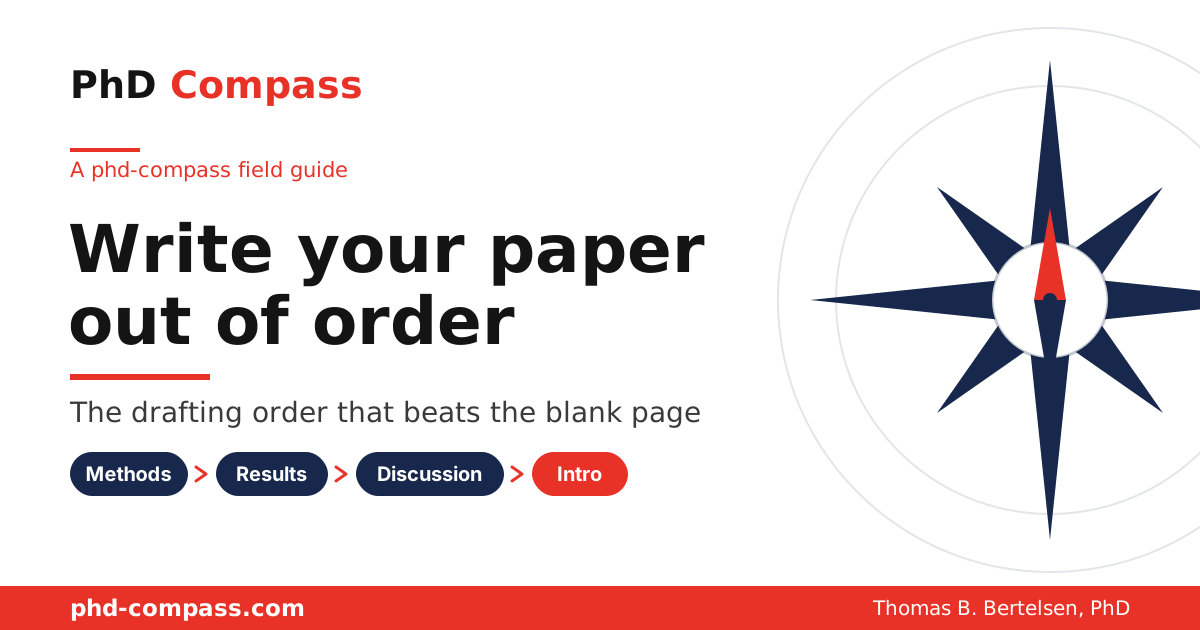
1. Method2. Results3. Introduction4. Discussion5. Abstract6. TitleStart with the method. It is the most concrete thing you own: participants, recruitment, procedure, the order things happened in, how each construct was measured. There is almost nothing to "figure out" — you are reporting decisions you already made. This is the gentlest possible on-ramp into a writing session, which is exactly why it belongs first.
Then results. Lay out the descriptive statistics first, then your main analyses, then the secondary and exploratory ones. Again: concrete. The numbers are the numbers. You are sequencing and explaining, not inventing.
By the time those two sections are drafted, something quietly important has happened — you now know what your paper is actually about. You know what you found, what held up, and what surprised you. Now the introduction is writable, because you finally know which gap your results fill.
Why the introduction genuinely comes near the end
This is the part people resist, so let me be plain about it.
The introduction's whole job is to make a promise the rest of the paper keeps: here is a gap in what we know, and this study fills it. You build that case in a clear arc — why the topic matters, what is already known, and then the precise thing that is not yet known (the gap your study addresses).
You cannot write that arc backwards from a result you do not have yet. Try to, and you will write toward the result you hoped for — and then spend the revision quietly bending your introduction to match what you actually found. Writing the introduction after the results closes that gap. You frame the exact contribution your data supports, the first time, instead of fictionalising it and patching it later.
There is one honest caveat worth naming. Gathering the raw material for the introduction — the background reading, the notes on why the topic matters, the sense of the literature — happens long before you draft any section. That groundwork is continuous throughout the project. But the writing of the introduction, the actual paragraphs, comes after the results are in hand. Reading early, drafting late.
After the introduction comes the discussion, where you take each main finding and relate it back to the literature you just framed — does it affirm, extend, or refute what was there before? That only works once the introduction has set the stage, which is why it sits where it does. Then the abstract (a short summary of the whole, written last because now you have a whole to summarise) and finally the title.
Don't draft each section as a finished block, either
One more thing, because "write the method first" can be misread as "write a perfect method, then a perfect results." That is just the same trap at a smaller scale.
Inside each section, I work in layers, not in one heroic pass:
- Strawman — headings, subheadings, key figures, and bullet points only. No full sentences yet. The single question here is: is the argument reasonable?
- Rough — replace the bullets with full prose and drop in the references. The question shifts to: is the argument clearly and well supported?
- Polished — now, and only now, you edit for flow and style. The question: is this easy and pleasant to read?
The reason this matters is that each layer answers a different question. If you try to polish a sentence while you are still unsure the argument underneath it is sound, you are buffing a wall that might get knocked down. Get the structure right in bullets first — it is cheap to move bullets around and expensive to rewrite three polished paragraphs. This is also, for what it is worth, the best way I know to brief a co-author: tell them upfront which draft you are sending and which question you want them to answer.
The habit layer: small sessions, protected focus
The order tells you what to write next. But order alone will not save you if your writing time is a single panicked binge the night before a deadline. So two habits sit underneath all of this.
First: write in regular, short sessions instead of bingeing. This sounds soft and motivational, but it is not — it is the more productive pattern, full stop. Writers who work in regular, unemotional sessions of moderate length tend to complete more pages, get more acceptances, and report less misery than those who write in rare, emotionally charged marathons. The minimum useful session is about 15 minutes a day. More is fine, but the regularity matters more than the length. The emotional charge of the once-a-week, high-stakes binge is itself part of the problem — not your effort, not your motivation, just the pattern of access to the work.
And here is where the order pays off again: when you can only spare 15 honest minutes, you need a low-activation-energy place to start. "Draft the method" is a task you can begin cold. "Write the introduction" usually is not. The readiness order and the small-sessions habit reinforce each other.
Second: protect those sessions from interruptions. Every interruption drops your concentration to zero, and getting back to full focus takes roughly 20 minutes each time. Do the multiplication. Four interruptions in a writing block is not a block — it is eighty minutes of refocusing wrapped around a few real ones. This is why long, concentrated writing is so rare in a meeting-heavy week, and why the answer is not "work more hours" but "reduce setup time." In practice that means: check email only at set times, block your writing slot like a meeting you cannot move, and — when you genuinely need depth — write somewhere people cannot tap you on the shoulder.
The walkthrough, start to finish
So, concretely, here is how I take an empirical paper from nothing to draft:
- Method, in bullets, then prose. Who participated, how you recruited them, what you measured. Easiest possible start.
- Results, in bullets, then prose. Descriptives, then main analyses, then secondary ones.
- Pause and notice what you actually found. This is the moment your paper's real argument becomes clear.
- Introduction. Now you can frame the exact gap your results fill — importance, what is known, what was missing (e.g. "we know X (Author, Year) and Y (Author, Year), but not yet Z" — placeholders, illustrative only).
- Discussion. Take each finding back to that literature: affirm, extend, or refute.
- Abstract, then title, last, once there is a finished whole to compress.
Run the whole thing in 15-minute-plus daily sessions, with the door shut and email closed, layering each section from strawman to polished. That is the entire method. There is nothing clever in it — which is exactly why it works for an average researcher like me.
Takeaway
If the page under Introduction keeps staying blank, the problem is almost never you. It is that you are asking the hardest, most uncertain section to go first. Flip the order. Start where the material is solid — methods and results — let those tell you what your paper is about, and write the introduction once you can write it honestly. Then protect the small, regular sessions that let you do it at all.
Which section freezes you most — the introduction, the discussion, or even the methods? Hit reply and tell me. I read every reply, and the patterns in your answers shape what I write next.
📄 Free template: To turn those drafted sections from notes into finished prose, grab "From Notes to First Draft" — the note-to-paragraph system I actually use. Subscribe to phd-compass and I will send it over. Get it here.
Member discussion