
How to Respond to Reviewer Comments (3 Ways to Handle Any Comment)
The email arrives. "We invite you to revise and resubmit." For half a second you're elated. Then you open the attachment, and Reviewer 2 has written the sentence every researcher dreads: "It is unclear what the authors are actually contributing here."
I have read that sentence about my own work more times than I'd like to admit. I finished my PhD on schedule and I've published around twenty papers, and I can tell you that not one of them sailed through clean. Every single one came back with comments that, on first read, felt like a verdict on me as a scientist.
Here's the reframe that changed how I work: a review is not a verdict. It's a navigable list of tasks. Once you stop reading peer review as a judgment and start reading it as a to-do list with three possible responses per item, the whole thing becomes manageable. Harsh, sometimes. Unfair, occasionally. But navigable.
This post is the method I actually use. It comes down to one idea: every reviewer comment, no matter how it's phrased, can be handled in exactly one of three ways. Learn to recognize which, and responding to peer review stops being an emotional ordeal and becomes a routine.
📄 Free template: I turned this exact method into a fill-in kit — "The Reviewer Reply Kit" — a response-letter template plus a phrase bank of ready-to-adapt lines for every kind of comment, including the hard ones you have to push back on. Subscribe to get it free.
First, the reframe: who actually decides
Before the three ways, one fact that takes the pressure off. The editor — not the reviewer — has final authority over whether your paper is published. Reviewers advise; the editor decides.
This matters enormously for how you respond. You are not writing to win an argument with Reviewer 2. You are writing to give the editor a respectful, reasonable, well-documented case for your paper. A response that is calm and well-reasoned can persuade the editor even when it does not fully satisfy a reviewer. So your tone is never "the reviewer is wrong" — it's "here is what we did, and here is why."
One more assumption worth adopting before you start: there is almost always a kernel of truth in every comment. Either you got something wrong, or you explained it badly — but something prompted that remark. Start from that posture and even the unfair-sounding comments become useful.
The three ways to respond to any reviewer comment
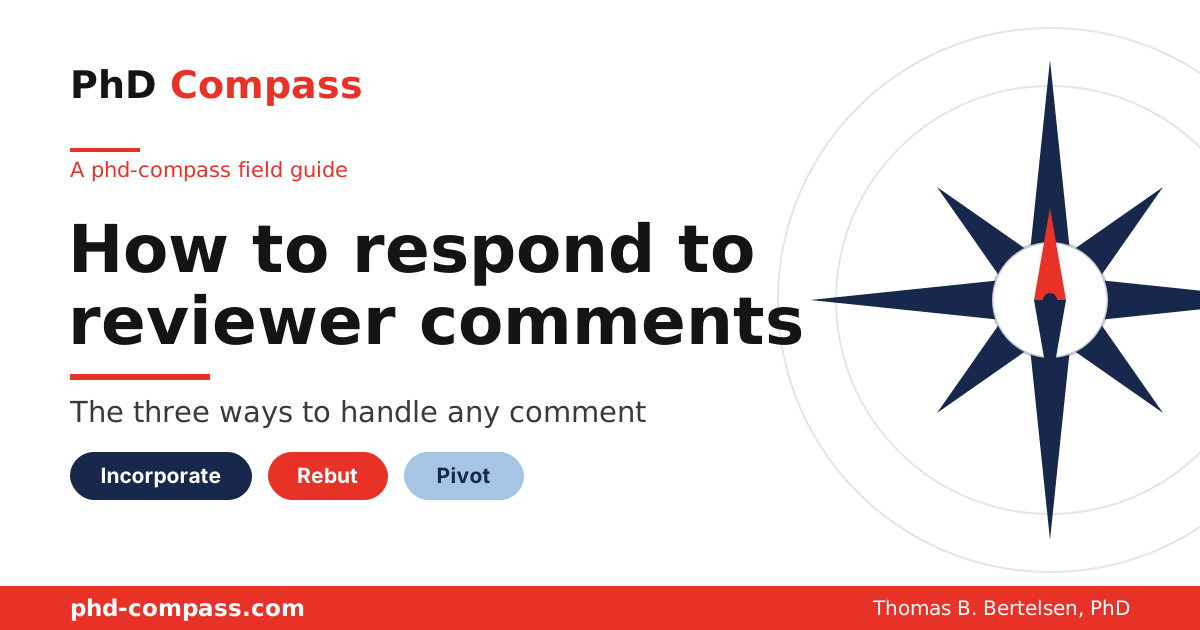
Here it is. Every comment you will ever receive can be handled in one of three ways:
- Incorporate — accept the suggestion and make the change.
- Rebut — decline the change, with a reasoned justification.
- Pivot — the middle path: acknowledge the comment and partially address it, explaining why full implementation would weaken the paper.
Your default goal is to agree wherever you reasonably can. When you've accommodated a reviewer's concerns, they have little basis left to oppose publication. But you should never make a change that genuinely makes the paper worse just to keep the peace. That's what the other two options are for.
Let's take each one.
1. Incorporate — when the reviewer is right (which is often)
Use this when the comment is correct, or when implementing it costs you little and improves clarity. Most comments fall here. Missing citations, an unclear sentence, an analysis you should have reported anyway, a limitation you genuinely overlooked — just fix it, and say so plainly.
Don't be stingy with agreement. Conceding a fair point quickly builds enormous goodwill and frees your energy for the one or two comments that actually need a fight.
Example response line:
We thank the reviewer for this point. We agree and have added the requested sensitivity analysis (see Results, p. 11) and updated the Methods accordingly (p. 6).
Notice it does two things: it thanks the reviewer, and it tells them exactly where to look. More on that below.
2. Rebut — when the reviewer is wrong, and it matters
Use this sparingly, for comments where implementing the change would damage the paper and you can defend your position with evidence or logic. A rebuttal is not "we disagree." It's a reasoned counter-argument, delivered respectfully.
The key is to argue from the literature or the data, never from ego. Give the editor something concrete to weigh against the reviewer's objection.
Example response line:
We appreciate this suggestion. We chose not to dichotomize the outcome variable here, because doing so discards variance and reduces statistical power (Author, Year — illustrative citation). We have, however, added a sentence clarifying our rationale on p. 8 so that readers do not have the same question.
See what happened there? Even in a rebuttal, I gave a little — a clarifying sentence — so the comment still produced a visible improvement. Which brings us to the third, and most useful, option.
3. Pivot — the diplomatic middle path
This is the one most researchers underuse, and it's the one that gets papers through. Use the pivot when the reviewer has identified a real concern, but their specific proposed fix isn't right. You acknowledge the concern, address the part you can, and explain why you're not going all the way.
The pivot signals good faith without capitulating. It tells the editor: we took this seriously, we moved toward the reviewer, and here is the principled reason we stopped where we did.
Example response line:
We agree that the generalizability of our findings deserves more attention. Rather than collecting an additional sample, which is beyond the scope of this study, we have expanded the Limitations section to address the boundary conditions the reviewer raises (p. 19) and softened our claims in the Discussion accordingly.
A useful trick lives inside that example: when you can't fully address a comment, the Limitations section is your friend. Almost any concern you cannot resolve directly can be honestly acknowledged as a limitation. That's not a dodge — it's good science, and reviewers know it.
How to structure the response letter
Your response letter is the most important document in this whole process — more important than the revised manuscript itself. Here's why: a good letter means the reviewers do not have to re-read your paper from scratch. And that matters more than you'd think. A reviewer who feels forced to re-read the whole manuscript is essentially reading it fresh — and they tend to come back more critical the second time. Your job is to guide them through exactly what changed, so they never have to.
Here's the workflow I use every time:
- Copy every comment into a new document and number them — 1.1, 1.2, 2.1, and so on (Reviewer 1's comments, Reviewer 2's comments). Nothing slips through the cracks, and you can reference each one precisely.
- Classify each comment by section affected (Introduction / Method / Results / Discussion) and by revision size — major (new analyses, restructuring), moderate (a new paragraph, a clarification), or minor (a typo, a missing reference).
- Run any new analyses first, before you write a single word of response. You don't want to discover halfway through writing that the result doesn't say what you hoped.
- Work in order of size: major comments touching Results and Methods first, then other major comments, then moderate, then minor. The big structural changes ripple into everything else, so do them before you polish.
- For each comment, in the letter: restate the comment, state your response (incorporate / rebut / pivot), describe exactly what you changed, and point to the page and line. Quote the new text if it's short.
- Be relentlessly respectful. Open replies with "We thank the reviewer…" even through gritted teeth. The tone of the letter is part of the argument.
A short worked mini-example
Say Reviewer 1 leaves this comment (illustrative):
1.3 — The sample size seems small for the number of predictors in the regression model. I am not convinced the results are stable.
Here's how I'd triage it. There's a real kernel of truth — a small sample with many predictors is a legitimate concern. So this isn't a clean rebuttal. But re-collecting data is off the table. That points straight to a pivot: address what I can, concede the rest honestly.
My response in the letter:
1.3 — We thank the reviewer for raising this. To assess the stability of our estimates, we have added a bootstrap analysis (1,000 resamples; see Table 3, p. 12 — illustrative example data), which produced consistent coefficient estimates. We acknowledge, however, that our sample remains modest relative to the model's complexity, and we now state this explicitly as a limitation (p. 18) and temper our conclusions in the Discussion (p. 16).
That single reply does the work: it thanks the reviewer, adds a concrete analysis that directly speaks to their worry, points to the exact locations, and honestly flags what the analysis cannot fix. The editor reading that sees a researcher acting in good faith — which is precisely what tips a borderline decision your way.
The takeaway, and keeping your sanity
Responding to peer review feels overwhelming because the comments arrive as one undifferentiated wall of criticism. The fix is to stop treating it as criticism and start treating it as a numbered list, where each item gets one of three responses:
- Incorporate when they're right (your default).
- Rebut, respectfully and with evidence, when a change would harm the paper.
- Pivot — move toward the reviewer, concede the rest to Limitations — when there's truth in the comment but their fix isn't right.
Agree where you can, defend what matters, and remember the editor decides. Do that across the whole letter and a revise-and-resubmit stops being a referendum on your worth and becomes what it actually is: the normal, navigable last mile before publication.
And about that sting on first read — let it pass before you reply. I open the file, feel the jolt, close it, and don't write a word for a day or two. The comments are exactly as serious the next morning, but I am far better company. Almost nothing in peer review needs to be answered today.
Your turn: what's the most brutal or baffling reviewer comment you've ever received? Reply to this email and tell me — I read every reply, and the strange ones are my favorite.
📄 Free template: on't write your response letter from a blank page. Grab "The Reviewer Reply Kit" — my fill-in response-letter template plus a copy-paste phrase bank for incorporating, rebutting, and pivoting on any comment. Subscribe to get it free.
Member discussion