
Why I Dropped Permanent Notes From My Zettelkasten
There is a lot to tinker with in regards to Zettelkasten. When I started out i followed Ahrens recommendations but I have made several refinements over the years. Two of the questions I most often get asked are: do I actually agree with Ahrens' stages of notes, the journey from fleeting to permanent? And do I write my notes in one sitting, or refine them over time?
These questions reflect the same underlying question. It's the question that stalled me longer than any other in my own note-taking: when is a note finally good enough to be a permanent note? If you built your vault from How to Take Smart Notes — fleeting notes at one end, a zettelkasten of permanent notes at the other — you've probably stood at that door, holding a note that's nearly done and somehow never done.
My answer to both questions turns out to be the same answer: I stopped using permanent notes. Not the notes — the category. What follows is what I do instead, why it holds up, and what still stands guard at the door.
The door everyone gets stuck at
Ahrens draws a clean line between fleeting notes — quick captures that exist only to be processed — and permanent notes, the durable, self-contained ones the system is actually built from (Ahrens, 2017). It's a genuinely useful line. The trouble starts with what most of us build out of it: a pipeline. Fleeting in, permanent out, and a stage in between where notes wait to be judged.
That middle stage installs a question at its exit: is this note good enough to be permanent now? Most advice on how to write permanent notes tries to answer it with standards — write for your future self, make it self-explanatory, polish until it stands alone. All reasonable. None of it tells you when to stop.
"Good enough to be permanent" is an unanswerable question installed as a workflow step. Permanent is a verdict about forever, and you can't inspect forever from here. So the note sits in the middle of the pipeline for weeks while you reread it, tweak a sentence, and quietly start dreading your own vault.
I loved the book — and stopped using one piece of it
Before I tell you what I dropped, let me be fair to the book: I loved it. It's what got me started, and most of my system still runs on its ideas. This is one honest divergence from someone the book helped enormously, not a takedown.
I should also say what kind of authority I'm claiming here, which is: not much. I finished my PhD on schedule and published 20 papers, and I'm a fairly average researcher — my edge was never talent, it was systems. So this is what works for me, offered as one tested option, not a fool-proof method.
What I stopped using is the three-stage progression — fleeting, then in progress, then permanent. In my hands, the stages weren't describing anything real. They were manufacturing a decision I didn't need to make.
Two states, not three
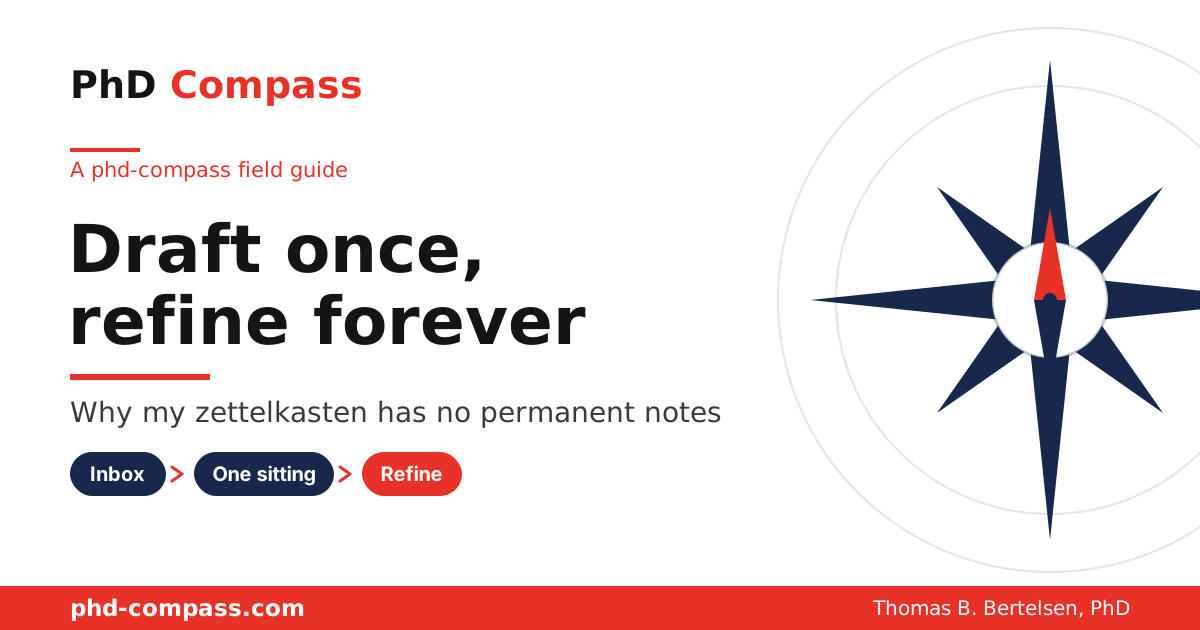
Here's my whole taxonomy now. Fleeting: my inbox, the decision-free capture area where everything lands first. Everything else: in progress — and it stays in progress, indefinitely.
To be precise, "in progress" isn't a folder in my vault, and there's no promotion ceremony waiting at the end of it. It's a stance: every note in my zettelkasten is a live document I'm allowed to reopen. What I removed wasn't a stage so much as the gate — the moment where a note must be declared finished.
For me, that one removal did most of the work. When there's no third state to graduate into, there's no graduation to overthink. A note can't be stuck at ninety percent done when "done" isn't a place. The question that used to eat my evenings — is this permanent yet? — simply has nothing left to attach to.
📄 Free kit: If your notes pile up but never become prose, that's the gap "From Notes to First Draft" is built for — the note-to-paragraph workflow I use myself. Grab it here (free, members only).
There's still a bar — it's just at the entrance
If notes are never finished, what stops the zettelkasten filling up with mush? A bar — but it sits at the door, and it's functional rather than philosophical.
When I process an inbox item worth keeping, I write the note in one sitting, until it's complete enough to function as a paragraph in an academic article. That's the entry standard, and it's the same paragraph test I've described before: could I paste this into a draft as a working paragraph — claim, development, evidence? My two atomicity questions live at the same door: usable in more than one context, and full enough to stand as a paragraph.
Notice what kind of question that is. Not is this note good enough for eternity? but would this work in a draft today? The first has no answer; the second you can answer while tired. The bar includes the boring parts too — a paragraph needs its citation attached, which in my case Zotero plus the Citations plugin in Obsidian handles nicely.
One idea per note still matters as much as ever, because single-idea notes are what recombine freely across projects (Ahrens, 2017). That part of the book I kept without modification.
Draft in one sitting, refine continuously
So the note clears the paragraph bar in one sitting. But that doesn't mean I'm done with it — and here the reader's two questions fuse into one practice.
When new knowledge arrives that would change the paragraph, I simply edit the note. No new version, no appendix at the bottom — the note today says what I know today, so it can still go straight into a draft. And when old knowledge is completely superseded rather than merely refined, I'll sometimes give the outdated view a dedicated note as historic practice: often worth citing as history, no longer as fact.
If you want the whole system in six words: draft in one sitting, refine continuously. The sitting gets the note over a real bar; the refining keeps it over that bar as the field moves. And that's what feeds the payoff Ahrens promises — thinking that accumulates instead of starting over, so every usable note makes the next piece of writing cheaper (Ahrens, 2017).
This isn't lowering the bar
A fair objection: haven't I just relaxed my standards and given the result a nicer name? I don't think so, and the distinction is worth being exact about.
The paragraph bar is a real bar, enforced at a real moment. A vague half-thought doesn't clear it. A claim with no evidence doesn't clear it. Two ideas tangled together don't clear it. What I dropped is not the demand that a note be usable today — only the pretence that it's finished forever.
Which suggests, at least in my practice, that "permanent" was never describing the note's state at all. It describes where the note lives: a permanent address in the system — linkable, findable, never deleted. Permanent home, provisional content. Once I read the word that way, the anxiety attached to it had nowhere left to live.
If you want to test this in a week
- Keep capturing into a decision-free inbox. Nothing changes there.
- For one week, refuse the question "is this permanent yet?" Allow two states only: inbox, and in progress.
- When you process a keeper, write it in one sitting until it could stand as a paragraph in an article — claim, development, evidence, citation attached. If it can't get there, something is usually missing; note what, and send it back to the inbox.
- When something you learn this week contradicts an existing note, edit the note directly — and see what happens. In my experience: nothing bad, and one less stale note.
(More on the wider system in the resources hub and in how to use the zettelkasten method for your PhD.)
The takeaway
The reader asked whether I agree with Ahrens' note stages, and whether notes are written once or refined over time. Same answer to both: I keep the fleeting/permanent distinction as a direction of travel and drop it as a gate. Two states, not three. One functional bar at the door — a paragraph you could use today — and an open editing licence ever after.
Draft in one sitting, refine continuously. My notes never become permanent. They just never stop being useful — which, I've come to think, is what "permanent" was promising all along.
📄 Free kit: The paragraph bar is exactly what "From Notes to First Draft" trains — my free note-to-paragraph checklist and outline worksheet. Get it here, free for members.
One question before you go. Hit reply and tell me: where do notes get stuck in your system — waiting at capture, waiting to be "good enough", or somewhere else entirely? I read every reply, and the answers shape what I write next.
Member discussion