
The Five-Sentence First Draft: Test Your Argument Before You Write It
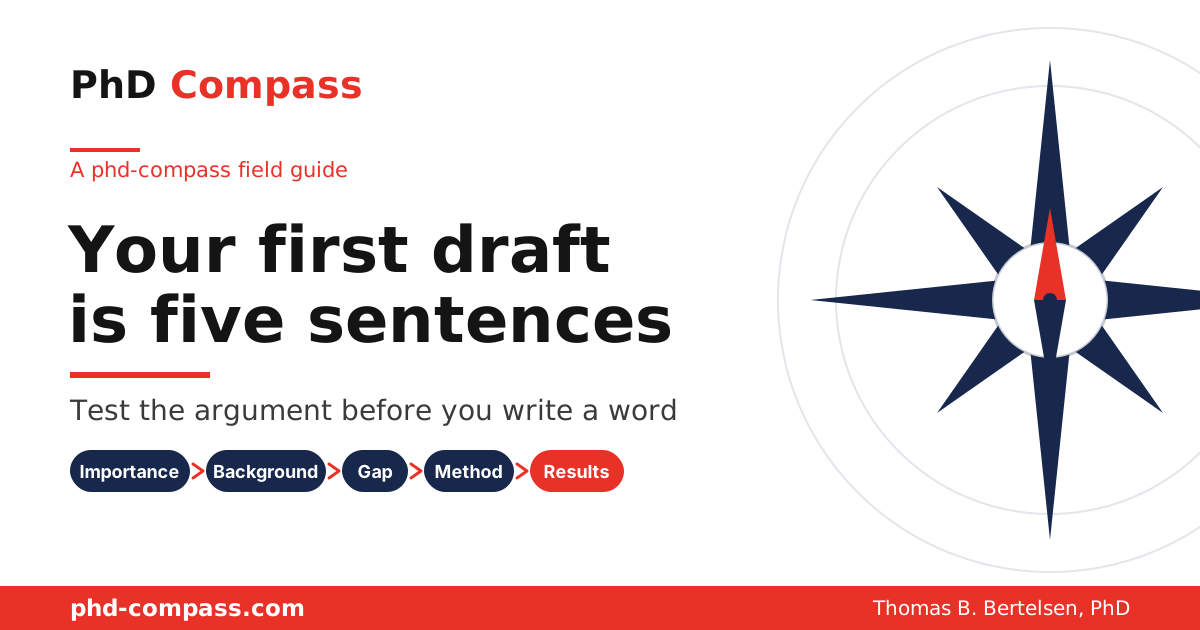
The first draft of your paper is five sentences long.
That is not a trick. It is the whole point of this post. Before you write a single paragraph, you write the argument itself — importance, background, gap, method, results, one sentence each. Then you test it, on yourself and on someone who knows nothing about your field. Only when those five sentences hold together do you earn the right to expand them.
Most advice on how to outline a research paper starts with headings and bullet points. This does not. An outline of sections tells you what order things go in. It does not tell you whether your argument actually works. The five-sentence skeleton does — and it does it in about ten minutes, before you have spent anything.
I am a fairly average researcher: a clinical psychologist and statistician who finished a PhD on schedule and has published around twenty papers. I am not fast because I am clever. I am reasonably efficient because I stopped writing introductions before I knew what I was arguing. This is the single habit that made the biggest difference.
Why the skeleton comes before the prose
No amount of polishing fixes a broken argument. The only question is whether you discover the break at the skeleton stage or after you have written three thousand words.
The skeleton is not a rough draft. It is a test. Before you invest a single hour in the language of your introduction, you write five sentences — one for each structural element — and check whether they hold together. If they do, you have your paper structure. If they do not, you have found out while it was still cheap to fix.
The biggest mistake here is writing the introduction first and pouring time into the words. Introductions invite this. They are the most visible part of the paper, the part you most want to get right, the part you imagine your reader encountering first. But entire sections can change or disappear once the argument is tested. You cannot justify polishing sentences you do not yet know you will keep.
📄 Free: Grab the Five-Sentence Skeleton Template — a fill-in-the-blank sheet (importance → background → gap → method → results) with prompts for each sentence and a checklist for testing every transition. Download it here.
The five sentences
The research paper argument has five structural elements, and each one gets exactly one sentence:
- Importance — why this matters
- Background — what we already know
- Gap — what we do not yet know
- Method — what you did to find out
- Results — what you found
Here is what that looks like in practice:
Anxiety is one of the most common and impairing conditions in children and adolescents. Cognitive-behavioural therapy has shown consistent effects for youth anxiety and has been adapted for delivery in school settings. However, it remains unknown whether classroom teachers can deliver CBT as effectively as trained psychologists. We conducted a randomised controlled trial comparing teacher-delivered and psychologist-delivered CBT for youth anxiety. Teachers were as effective as psychologists.
Five sentences. Thirty seconds to read. And immediately you can assess the logic:
- Does the background set up the gap?
- Does the gap point directly to the method?
- Does the method address the question the gap opens?
- Do the results answer that question?
- Does each sentence earn the next?
If the answer to any of these is no, you have a structural problem that prose cannot fix. Better to see it now than after drafting an introduction that no longer fits the argument you eventually land on.
Write roughly. The skeleton should take no more than ten minutes. Its job is not to be good — its job is to show you whether the bones are in the right place. A sentence that reads awkwardly but captures the logic correctly is exactly what you want. A beautiful sentence that hides a logical gap is exactly what you do not.
I have come back from this step satisfied every single time. That consistency is the whole story. The skeleton has never cost me time, and it has repeatedly saved it. Every article I have gone into with a skeleton I had already tested wrote faster, and its structure held through revision. The argument was not something I was still working out while writing the introduction — it was something I had already checked.
When is the argument good enough?
Here is the test: if you need three sentences to explain your first sentence, the argument is not ready.
Not whether an expert would approve your framing. Not whether you have cited the right papers behind each claim. Not whether the language sounds sufficiently academic. The test is whether a normal, reasonably intelligent person who knows nothing about your field can read the five sentences and follow the logic without help.
If they can, the argument is ready. If they cannot, the problem is in the argument — not in the reader.
There are two ways it usually fails.
The first is qualification. You write the importance sentence and immediately feel the urge to add a clause: "but only in certain age groups," "with the caveat that effect sizes vary," "specifically in clinical rather than community samples." Each clause is a signal. It means the sentence is doing more than one thing, or it is not quite saying what you mean, or the claim is not as clean as it needs to be. A skeleton sentence should stand alone. If it needs scaffolding before the next sentence makes sense, the argument has a gap.
The second is vocabulary. Academic language can make an argument sound more complete than it is. Concepts that would take paragraphs to define get dropped into skeleton sentences as if they were self-explanatory — and now you cannot tell whether the logic holds, because the terms are doing work that logic should be doing. Strip the vocabulary out. Say what you are actually trying to say. A sentence that survives the plain-language test has a clear claim beneath it. A sentence that only works in academic language may not have one.
There is a misconception worth naming directly: that simplicity means unsophistication. It does not. The most rigorous arguments are the ones that can be stated simply. Complexity in expression is usually evidence of confusion in thought, not precision. When someone asks what your study is about and you need five minutes to answer, that is not because the study is too subtle to explain simply. It is because the argument has not been fully worked out yet.
The colleague who fixed my paper in two sentences
I once spent a long time on the skeleton for one of my papers. Every version almost worked, but something about how the pieces fit together was always slightly off.
A colleague sat down with me and asked me to explain what I was trying to say. I talked for a few minutes. He listened, and then said: "So what you mean is—" and in two sentences he described my argument more clearly than I had in weeks of drafting.
That plain-language summary became the skeleton. All the academic framing I had been trying to bolt together had been obscuring something that, once stated simply, was obvious.
If a non-expert can follow it, the argument is ready. If they cannot, the problem is not their expertise — it is your argument. Go back and simplify until the logic is clear without help.
Where this leaves you
The skeleton is the cheapest test your paper will ever get. Five sentences take ten minutes to write and thirty seconds to read, and they expose structural problems that would otherwise hide inside three thousand words of polished prose. A skeleton a non-expert can follow is an argument that will hold. A skeleton that needs extra clauses and definitions to survive is telling you to go back.
And once the skeleton is tested, expansion becomes mechanical in the best sense: each sentence becomes a section, and each section becomes paragraphs where every paragraph has one job.
Test the argument before you write it. Five sentences, one pass.
📄 Free: The Five-Sentence Skeleton Template walks you through all five sentences with prompts and a checklist for testing each transition — importance → background → gap → method → results. Download it here.
Try it now. Write the five sentences for the paper on your desk right now, and reply with your five sentences — I'll tell you if the logic holds. I read every reply.
Member discussion